

Dallas, TX
Car shipping Dallas
The busiest carrier hub in Texas; trucks pass through DFW on nearly every east–west lane.
City guide
South · TX
Into Texas from $750 · Out of Texas from $750 · Door-to-door in Dallas–Fort Worth, Houston, Austin and statewide
Compare quotes from licensed, bonded carriers.
No obligation · Takes 60 seconds · We never sell your data
Texas is where the country's relocation traffic converges. Job moves into Dallas–Fort Worth, Houston and Austin, university terms in Austin and College Station, military families rotating through the state's installations and a large trade in trucks bought and sold across state lines keep carriers busy in every month. Unlike Florida there is no winter snowbird spike; the peak is May through August, when household moves and student arrivals overlap, and the quiet months are November through February.
The interstate map explains the prices. I-10 runs the full width of the state from El Paso to Houston and on to Florida, I-20 and I-30 bring traffic from the east into Dallas, I-35 runs north–south through Dallas, Austin and San Antonio, and I-45 links Dallas and Houston. All four big metros sit on crossings, so a carrier arriving from any direction finds an outbound load waiting, which keeps inbound rates low. The exception is distance within the state: Houston to El Paso is about 750 miles, so a west Texas delivery from an eastern origin is a longer, separately priced lane.
This page covers the cost of shipping into and out of Texas from the main origins, the inbound and outbound routes carriers run, the six Texas cities with their own guides, and the local details that matter: pickup trucks and their modifications, downtown truck restrictions, spring hail and the ports.
Inbound
The lanes carriers run into Texas most often, with current open and enclosed ranges.
| Pickup | Distance | Transit | Open carrier | Enclosed |
|---|---|---|---|---|
| From California | 1,500 mi | 3–6 days | $1,000 – $1,400 | $1,450 – $2,050 |
| From Los Angeles, CA | 1,440 mi | 3–5 days | $975 – $1,350 | $1,400 – $1,975 |
Sedan, running, standard pickup window. Select a route for the full price table by vehicle type.
Outbound
Leaving Texas? These are the destinations with the most carrier capacity.
| Delivery | Distance | Transit | Open carrier | Enclosed |
|---|---|---|---|---|
| To Florida | 1,100 mi | 3–5 days | $850 – $1,250 | $1,250 – $1,800 |
Sedan, running, standard pickup window. Select a route for the full price table by vehicle type.
Cities
Each city guide covers pickup logistics, the nearest carrier terminal and price examples to the most common destinations.
Dallas, TX
The busiest carrier hub in Texas; trucks pass through DFW on nearly every east–west lane.
City guide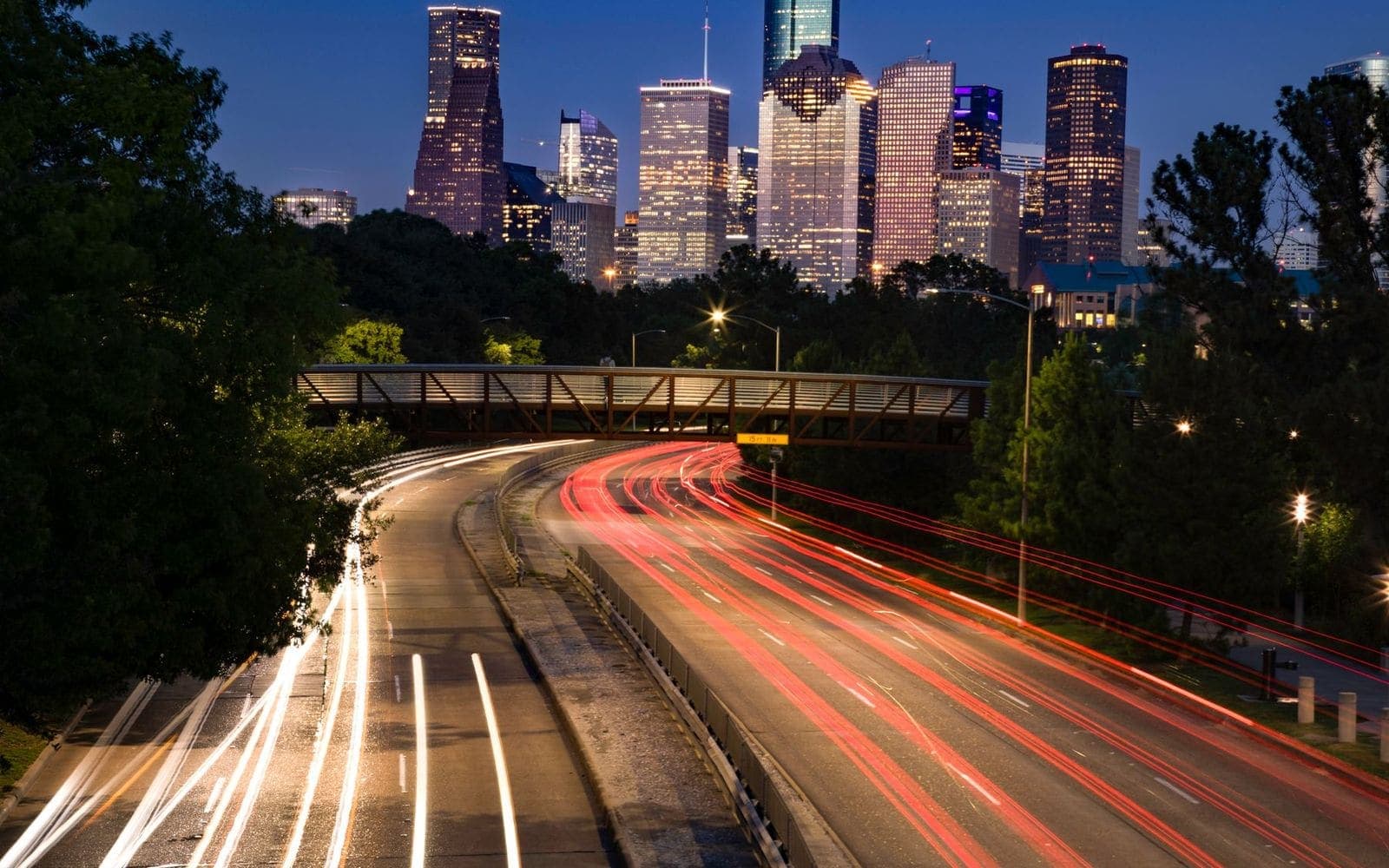
Houston, TX
Gulf Coast port city with direct I-10 service to Florida and California.
City guide
Austin, TX
Tech relocations from California keep the I-10 lane into Austin busy year-round.
City guide
San Antonio, TX
Military City USA: Joint Base San Antonio drives constant PCS vehicle moves.
City guide
Fort Worth, TX
Western half of the Metroplex, with Alliance logistics hub and Naval Air Station JRB.
City guide
El Paso, TX
Fort Bliss PCS moves and I-10 pass-through carriers between Phoenix and San Antonio.
City guideCost
Running sedan, flexible pickup window. Ranges come from carrier quotes received on these lanes and are re-checked each season; inbound Texas shipments run $750–$1,500 on the busiest lanes.
| Lane | Open carrier | Enclosed carrier | Transit |
|---|---|---|---|
| California to Texas (1,500 mi) | $1,000 – $1,400 | $1,450 – $2,050 | 3–6 days |
| Los Angeles to Dallas (1,440 mi) | $975 – $1,350 | $1,400 – $1,975 | 3–5 days |
| Florida to Texas (1,100 mi) | $850 – $1,250 | $1,250 – $1,800 | 3–5 days |
| New York to Texas (1,550 mi) | $1,050 – $1,500 | $1,550 – $2,150 | 4–6 days |
| Illinois to Texas (950 mi) | $750 – $1,050 | $1,100 – $1,550 | 2–4 days |
| Georgia to Texas (800 mi) | $675 – $950 | $975 – $1,400 | 2–4 days |
| Colorado to Texas (800 mi) | $675 – $950 | $975 – $1,400 | 2–4 days |
Running sedan, flexible pickup window. SUVs add about 12%, pickups 20%, inoperable vehicles about $150.
Texas is one of the largest inbound relocation markets in the country and, unlike Florida, its demand is spread across the year with a summer peak rather than a winter one. From California, the most common origin, a sedan costs $1,000–$1,400 on an open carrier for the roughly 1,500 miles to Dallas, Houston or Austin; Los Angeles to Dallas, the single busiest city pair, is $975–$1,350. From Florida it is $850–$1,250, from Illinois $750–$1,050, from Georgia or Colorado $675–$950, and from New York $1,050–$1,500. Enclosed adds 40–60% on every lane.
The table above sets out the main origins with distances, ranges and transit windows. Two features of the Texas market shape those numbers. The first is that Dallas–Fort Worth, Houston, Austin and San Antonio all sit on major interstate crossings, so carriers arriving from any direction have loads waiting to take them out again; that keeps inbound prices low. The second is the size of the state. El Paso is closer to Phoenix than to Houston, so a west Texas delivery from an eastern origin is priced as a different, longer lane. The quote form uses your actual delivery city.
Summer is the busy season. Corporate relocations, new-hire moves and university terms concentrate demand between May and August, and prices run 5–10% higher then. Autumn and winter are quieter and cheaper.
Neighbouring states are a one- to two-day trip; Florida and the Midwest three to five; California three to six; the Northeast four to six. Price follows at a falling per-mile rate.
Dallas–Fort Worth, Houston, San Antonio and Austin are on major interstate crossings and price lowest. West Texas and the Panhandle are separate, longer lanes.
May through August brings job moves and student arrivals. Expect the top of the range then and the bottom in November through February.
Texas ships more pickups than any other state. A pickup adds about 20% to the sedan price; a lifted truck or a dually up to 45% because of deck height and weight limits.
Open is the default. Enclosed adds 40–60% and makes sense for classics, exotics and low-clearance cars, or for hail-season shipments into north Texas in spring.
Downtown Austin, the Houston inner loop and parts of Dallas restrict car haulers. Drivers arrange a nearby meeting point; it is routine and does not change the price.
Avoid the summer peak if your dates allow. A shipment in October, November, January or February typically lands at the low end of the range, while the same lane in July is 5–10% higher. If the move is tied to a start date in summer, book two to three weeks ahead and give a pickup window of a few days; carriers building loads toward Texas place flexible cars first.
Deliver to a major metro. Dallas–Fort Worth, Houston, San Antonio and Austin are all cheap to reach because carriers have outbound loads waiting. A delivery an hour or two outside them is fine but costs a little more, and a delivery in the Panhandle or far west Texas is a different lane entirely.
Choose open transport for a daily driver or a work truck, and be exact about the truck: a lifted pickup or a dually needs a carrier that can take the height and weight, and telling us up front avoids a price change at pickup. Two vehicles from the same address ship cheaper together.
After delivery
The paperwork Texas asks of a new resident, so you can book the DMV visit for the week the car lands rather than discover it at the counter.
Register within 30 days of moving to Texas.
No stand-alone VIN verification form for a vehicle with a clean out-of-state title; the county tax office handles title and registration together. Ask the office whether an inspection report must accompany the title application in your county.
The annual safety inspection for non-commercial vehicles ended on 1 January 2025. An emissions inspection is still required before registration in 17 counties, including Dallas, Tarrant, Collin, Denton, Harris, Fort Bend, Montgomery, Travis, Williamson and El Paso. Out-of-state inspections are not recognised.
Proof of Texas insurance is required.
Source: Texas Department of Motor Vehicles (TxDMV) . Checked September 15, 2026. Deadlines and inspection rules change; confirm on the official page before you go.
Texas ships more pickups than any other state, and the trailer has to fit the truck. A standard half-ton pickup takes a normal position at about 20% above a sedan's price. A lifted truck, a long-bed crew cab or a dually needs deck height and weight allowance that not every carrier has, and prices up to 45% above a sedan. Telling the specialist the exact configuration, including tire size and any lift, is the difference between a truck that loads on the day and one that turns up unable to.
City access varies. Downtown Austin, the Houston inner loop and parts of central Dallas restrict car haulers on many streets, so drivers arrange a meeting point at a large lot near the interstate. The suburbs are easy: wide streets, long driveways and few gates. San Antonio and Fort Worth are straightforward almost everywhere.
Spring hail is the weather event that matters. North Texas from March through May sees storms that can dent an open-carrier load in minutes. Carriers watch the radar and pause loading when a cell is coming through, but a customer shipping a valuable car into Dallas–Fort Worth in April has a fair reason to consider enclosed transport. Summer heat is a non-issue for the shipment itself, though a car left in the sun for a day before pickup should be started to confirm the battery.
For international moves, carriers deliver to freight forwarders at Port Houston, the Port of Galveston and the Port of Corpus Christi, and to customs brokers on the border at Laredo and El Paso. The domestic leg is priced like any other delivery; the international leg is arranged with the forwarder. Paperwork for a domestic shipment is only keys and a photo ID at pickup, plus the name and number of whoever receives the car. Texas requires no state form to ship a vehicle in or out.
Services
Chosen from what ships on these lanes, not a generic list.
Coast to coast in 7–10 days on I-40, I-70 or I-80. Priced per mile far below short hauls.
Learn moreThe carrier picks up and delivers as close to your address as the truck can safely get. No terminals, no extra trips.
Learn moreThe standard for 9 in 10 shipments. Two-level open trailers, lowest cost, fastest pickup.
Learn moreQuestions
Not covered here? A specialist can answer route-specific questions in a couple of minutes.
888-706-8784$750–$1,500 for a running sedan on an open carrier, depending on origin: $675–$950 from Georgia or Colorado, $750–$1,050 from Illinois, $850–$1,250 from Florida, $1,000–$1,400 from California and $1,050–$1,500 from New York. Enclosed adds 40–60%.
One to two days on the truck from neighbouring states, two to four from the Midwest and Southeast, three to six from California, four to six from the Northeast. Add one to five days for carrier assignment and pickup.
Dallas–Fort Worth, at the junction of I-20, I-35 and I-45, followed closely by Houston and San Antonio. Austin prices similarly but downtown pickups usually need a meeting point. El Paso is a separate lane, cheap from the west and dearer from the east.
About 20% more than a sedan for a standard half-ton; a lifted truck, a long-bed crew cab or a dually can be up to 45% more because of height and weight limits on the trailer. Tell us the exact configuration so the right carrier is assigned.
May through August, when corporate relocations and university terms overlap. Prices run 5–10% higher then. There is no winter snowbird spike, so November through February is the quietest and cheapest period.
Carriers deliver to freight forwarders at Port Houston, Galveston and Corpus Christi and to border brokers in Laredo and El Paso; the international leg is arranged separately. Tell us the forwarder and the cut-off date.
Not the shipment itself, but a car that sits at a summer pickup for hours can have a weak battery by loading time. Make sure it starts on the day, and leave the tank at a quarter so it is light on the truck.
Dallas–Fort Worth, because it sits at the crossing of I-20, I-35 and I-45 and sees the most carrier traffic. Houston and San Antonio are close behind. Austin prices similarly but often needs a meeting point because of downtown truck restrictions. El Paso is on the I-10 line and cheap from the west, dearer from the east.
A pickup adds about 20% to the sedan price because of its weight and length; a lifted truck or a dually can add up to 45%. Tell us about modifications so the carrier assigned can actually take the vehicle.
The reverse lane, Texas to California, prices within about 10% of the inbound one. Fall and winter are its quieter months.
Carriers run I-10 and I-20 daily. Tell us the route and vehicle and a specialist will confirm the price and the earliest pickup.
Average response time under 5 minutes during business hours (Mon–Sun 7am–9pm ET).
Last updated September 12, 2026 · Written by the AutoShippingUS Editorial Team · Reviewed by Christofer Whiteman, Editor · Industry review by Sarah Williams, Independent auto transport consultant, 20 years in the industry